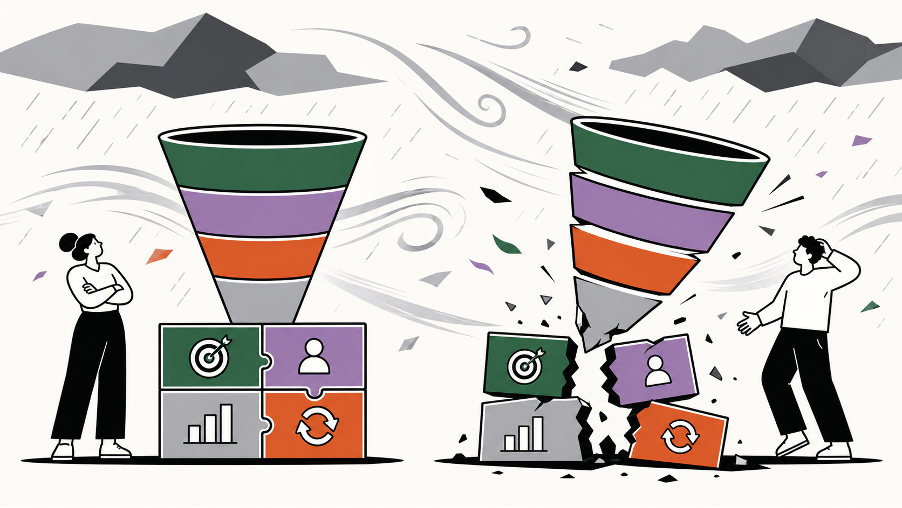
When economic conditions become less predictable, marketing is often one of the first budgets put under pressure. But reducing marketing spend as an automatic response can create more problems than it solves.
That’s not to say businesses should keep spending exactly as before. But rather, that effective marketing during economic uncertainty means understanding what has changed, where performance is shifting and which investments continue to support both immediate results and longer-term growth.
Before cutting marketing spend, businesses need to understand what is actually underperforming and why. A drop in revenue doesn’t necessarily mean marketing investment is the problem.
Snapshot
- Economic uncertainty should trigger closer analysis, not automatic marketing cuts.
- Falling revenue does not always mean acquisition is the problem.
- Weakness can sit anywhere across the customer journey, from traffic quality and website performance to sales follow-up, nurturing and retention.
- SEO, content, email, brand and customer data should be measured according to the role they play, not only by immediate revenue.
- Marketing activity should be assessed as something to protect, adjust, investigate or reduce based on evidence.
Economic uncertainty is not a universal instruction to spend less
Australian businesses are feeling the pressure of an ongoing cost of living crisis, elevated household expenses and more cautious consumer behaviour, operating in conditions where inflation and interest rates are rising.
That does not mean every industry is experiencing the same level of pressure, nor does uncertainty automatically mean recession.
Some customers may delay purchases. Others may compare more options, trade down or require more reassurance before buying. Some categories may remain relatively stable.
The right marketing response depends on what is changing in your market.
The Reserve Bank of Australia’s 25th August meeting minutes point to an economy under pressure, but not one experiencing a broad collapse in demand. After three cash rate increases in 2026, the RBA assessed financial conditions as somewhat restrictive, with mortgage repayments nearly rising to their 2024 peak as a share of household disposable income. Consumer sentiment also remained very weak, while household consumption was easing only gradually.
Inflation remains a key concern, with underlying inflation reaching 3.6% in the June quarter. The RBA also noted that customer price sensitivity may limit how much businesses can pass higher costs on to consumers.
For marketers, this suggests a more cautious and uneven customer environment. Buyers may take longer to decide, compare more options and place greater weight on price, value and reassurance. Rather than assuming weaker revenue means marketing has failed, businesses should assess where customer behaviour and performance are actually changing before reducing spend.
ABS data released on 26 August shows the Consumer Price Index rose 3.5% in the 12 months to July 2026, easing from 3.8% in June. However, underlying price pressures remained firmer, with trimmed mean inflation holding at 3.6%. Housing was the largest contributor to annual inflation, rising 5.0%, while food and non-alcoholic beverages increased 3.2%.
For businesses, this suggests household budgets are still facing pressure even as headline inflation eases. It does not mean all consumers are spending less, or that every category will experience the same effect. Higher essential costs can make some customers more price-conscious or selective, reinforcing the need to compare broader economic conditions with your own customer, conversion and sales data before changing marketing investment.
Economic data should influence your assumptions.
Your own customer data should determine what you do next.
Cutting Marketing isn’t a strategy
When revenue weakens, marketing spend is an easy line item to question and justify.
But falling revenue does not automatically mean acquisition has failed.
If paid search is still generating qualified visitors but conversion rates have declined, cutting the campaign does not explain why those visitors stopped converting.
Review the following:
- traffic and lead quality
- conversion rates
- sales cycle length
- average order value
- lead-to-sale conversion
- repeat purchase behaviour
- customer acquisition cost
- customer retention
Before reducing marketing spend, establish whether marketing is genuinely underperforming and, more importantly, which part of marketing activities are underperforming.
That is why marketing, website performance, CRM data and sales feedback need to be reviewed together.
Alongside this, competitor activity should also inform your strategic decision. If competitors maintain their marketing investment while you cut back, you risk losing visibility and falling further behind, particularly when customers are comparing more options. On the other hand, if competitors reduce spend while demand remains, maintaining effective activity can create an opportunity to capture more attention and potentially increase market share. The key is to assess competitor behaviour alongside your own performance data before deciding what to reduce.
Find where the weakness actually is
Channel diversification is often presented as the solution to marketing risk, however, it’s not that simple.
A business with three well-understood channels can be more resilient than one spread across ten.
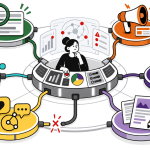
Resilience comes from understanding how your chosen channels contribute to the wider system.
Acquisition
Start by asking whether you are still reaching the right people.
Have search volumes changed? Are paid media costs rising? Has lead quality deteriorated? Are campaigns attracting customers with weaker purchase intent?
If acquisition is genuinely becoming less efficient, budgets, targeting, creative or channel allocation may need to change.
If qualified traffic remains relatively stable, the problem may be further downstream.
Website and conversion
Economic uncertainty can make customers more considered in how they evaluate businesses.
That places greater pressure on the website to answer questions, establish trust and make the next step easy.
Slow load times, unclear messaging, weak product information, poor mobile experiences or checkout friction can become more costly when customers are already hesitant.
A website that converted adequately during stronger demand may become an obvious weakness when buying behaviour changes.
Sales follow-up and nurturing
For lead-generation businesses, marketing can perform well while revenue still declines.
The weakness may sit in the handover between marketing and sales.
- Are leads being contacted quickly?
- Has the sales cycle lengthened?
- Are objections changing?
- Are prospects asking for more information before committing?
If customers take longer to decide, email marketing, remarketing, useful content and CRM automation also become more important. They allow the business to remain relevant while the customer moves through a longer consideration period.
Retention
Acquisition is only one side of growth.
If customers are buying less frequently, spending less or failing to return, retention may be a larger commercial problem than new customer acquisition.
Email, customer segmentation, post-purchase communication and customer service can all influence the value created after the initial conversion.
Economic pressure can expose weaknesses anywhere from acquisition through to retention. If you only look at marketing spend, you may miss the part of the system that actually needs attention.
Don’t judge every marketing activity by immediate revenue
Budget pressure often favours channels closest to conversion, but SEO, content, email, brand and customer data each play a different role across the customer journey.
- SEO helps capture existing demand, while content supports research, comparison and decision-making.
- Email helps nurture prospects who are not ready to convert immediately and can support repeat purchases over time.
- Brand activity strengthens recognition and trust.
- Customer data improves targeting, personalisation, measurement and the quality of decisions across other channels.
These investments still need to be accountable, but they should be measured according to the role they play, not only by immediate revenue.
If every activity is judged by the final click, businesses risk cutting the assets that help create, nurture and convert demand over time.
As Google and Meta rely increasingly on automated targeting, bidding and optimisation towards the signals they receive. They cannot decide which commercial outcomes matter most to your business.
Automation can improve execution. It does not replace strategy.
Assess what to protect, adjust, investigate or reduce
Rather than asking what should be cut, divide marketing activity into four categories.
Protect
Protect activity that continues to play an important role and would be difficult or expensive to rebuild.
This could include strong organic visibility, reliable high-intent acquisition, effective email databases, valuable customer data or high-performing lifecycle campaigns.
Adjust
Reallocate or refine activity where the opportunity remains but execution needs to change. This may mean changing budgets, creative, offers, landing pages, content priorities or audience focus depending on changes in customer behaviour.
Investigate
If performance has deteriorated and the reason is unclear, investigate before cutting. Review acquisition, website behaviour, sales processes, customer data and tracking together.
Reduce
Remove persistently inefficient activity, duplicated tools or channels with no clear commercial role.
A resilient strategy is not about protecting every marketing activity.
It is about knowing what can be removed without weakening something more valuable elsewhere.
Uncertainty exposes what you don’t understand
Economic uncertainty does not automatically make a marketing strategy weak. It makes weaknesses harder to ignore.
If a business does not know where leads come from, why customers convert, how long the buying process takes or which channels influence the customer journey, changing conditions make marketing decisions much harder.
A stronger marketing system provides enough visibility to identify where performance has shifted and respond accordingly.
Sometimes that means cutting spend. Sometimes it means reallocating it. Sometimes it means improving the website, sales process or customer nurturing instead.
And sometimes it means protecting an investment whose value appears over a longer period.
The more useful question during economic uncertainty is not:
“What can we cut?”
It is:
“What has changed, where is the weakness, and what role does each investment play in the wider customer journey?”
That is what makes marketing more resilient: not the ability to predict what happens next, but the ability to understand the system well enough to know what to change when conditions do.
Final Thoughts
Economic uncertainty should not push businesses into making faster marketing decisions. It should push them into making better ones. The strongest strategies are not the ones that avoid change, but the ones that can adapt without losing sight of how demand is created, nurtured and converted. When budgets are under pressure, the priority should be to identify what is genuinely underperforming, protect the assets that continue to create value, and make changes with a clear understanding of the wider marketing system.