Does your business use AI somewhere in their marketing?
It’s likely you have integrated AI into your business’ marketing across various activities. So, even if you haven’t formalised the process, these recent changes aren’t something you’d want to ignore.
A team member may use Claude to shape a blog draft. An advertising platform may generate copy variations. A CRM tool may help write an email sequence, while a chatbot answers customer questions on the website.
Until recently, most of that activity was difficult to trace. That is beginning to change.
A form of AI watermarking has been announced for new supported Claude models. The watermark will be invisible to readers, but it can indicate the likelihood that Claude was involved in producing a passage. Supported files can also carry signed information about their origin.
This is not a reason to distrust AI-assisted content. It is a reason to look more closely at how that content is created, checked and approved before it reaches customers.
Snapshot: What Businesses Need to Know
-
- New supported Claude models will include an invisible, machine-readable watermark in generated text.
-
- A detected mark can indicate Claude’s involvement, but not that it wrote every word.
-
- The absence of an AI marker does not confirm that content was created without AI.
-
- The main risk remains inaccurate, generic or poorly reviewed material.
-
- Businesses need defined processes for AI use, verification, approval and measurement.
What Is AI Watermarking?
AI watermarking creates a detectable pattern within AI-generated material.
In Claude’s case, it is not a hidden label or string of characters. It is formed through subtle patterns in the word choices made during generation. Readers will not notice a difference, but a detection system with the right key can assess whether Claude was likely involved.
Think of it less like a logo stamped onto a document and more like a statistical signature within the language.
Anthropic says detection becomes more reliable across longer passages. The signal may be weaker in short text, factual passages, code or lightly edited human writing, while heavy rewriting can reduce it further.
Content provenance simply means knowing where a piece of content came from and how it changed.
Watermarking should therefore be treated as an indication of AI involvement, not a complete record of authorship.
Why This Matters to Businesses
AI now influences content research, SEO planning, ad creation, email workflows, website messaging, reporting and customer service.
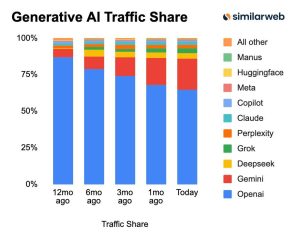
Similarweb reports that average monthly visits across generative AI platforms reached 9.5 billion between June 2025 and May 2026, up 70 per cent year on year.
The important point is not which platform is leading, rather that AI has become part of everyday digital behaviour.
One AI-assisted draft can quickly become a blog, social post, advertisement, landing page and automated email. If the original information is wrong or poorly framed, the same weakness can appear across the customer journey.
Watermarking makes provenance more visible, but the underlying issue is accountability. A business still owns the message it publishes.
Should Businesses Stop Using AI for Content?
No.
The more useful distinction is between AI-assisted marketing and AI-dependent marketing.
AI can support research, planning, drafting, analysis and repetitive production. Human expertise should still guide factual accuracy, source selection, commercial judgement, brand position and final approval.
The problem is not that AI contributed to a piece of marketing. The problem is publishing material that nobody properly checked because the tool sounded confident.
What Businesses Should Do Now
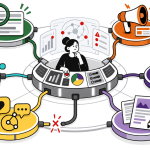
1. Map Where AI Is Already Being Used
Review where AI contributes to content, SEO, advertising, email, CRM workflows, social media, websites, reporting and internal planning.
For each use, record the tool, the information it can access, what it produces and who reviews the output.
Omni can support this through a connected digital strategy review. The purpose is not to document every prompt, but to identify where AI adds useful efficiency, where risk sits and where ownership is unclear.
2. Match Human Review to the Level of Risk
Not every AI-assisted task needs the same approval process.
An internal summary carries less risk than a public product claim, a statistic in an advertisement or an automated customer message. Review requirements should reflect the consequences of an error.
Depending on the material, checks may cover:
-
- original sources and factual claims
-
- subject-matter input
-
- privacy and data use
-
- brand voice and customer relevance
-
- final approval by a named person
Omni can help build these checks into content, campaign and automation workflows, so quality control becomes part of the process rather than a last-minute task.
3. Add What AI Cannot Know About Your Business
AI can organise information, but it does not automatically understand your customers, internal expertise or commercial position.
Strong content adds something specific to the business, such as customer questions, first-party data, sales insights, practical experience or a considered point of view.
This matters for SEO because visibility alone is not enough. Content must address genuine search intent and give readers a reason to trust the source.
It also matters for paid media and conversion because the promise in an ad should match the landing page, offer and follow-up experience.
Omni’s content, SEO, advertising, automation and web teams assess these touchpoints together. The aim is to maintain a consistent customer experience, not simply produce more material.
4. Measure Contribution, Not Volume
AI makes it easier to produce more blogs, ads and emails. Output is not the same as performance.
Businesses should assess qualified traffic, lead quality, conversion rates, advertising efficiency, engagement, production time, revisions and factual errors.
Omni can connect reporting across search, advertising, websites and CRM systems to show where AI is improving the process and where it is creating activity without better results.
Content Authenticity Is Now a Marketing Issue
As basic content becomes easier to produce, volume becomes a weaker advantage.
Businesses still need to give customers, search engines and AI-powered discovery tools a reason to trust their information.
That comes from reliable evidence, useful expertise, consistent positioning and a customer experience that supports the claims being made.
Human-written content is not automatically better. It can still be generic or inaccurate. The standard should be the value and defensibility of the finished work, regardless of which tools contributed to it.
For businesses using AI across several channels, content, SEO, advertising, automation and website experience should reinforce one another rather than operate as separate production lines, this is where Omni can help.
A Note for Businesses Working in the EU
Businesses operating in the European Union, or using AI-generated outputs within the EU, should consider whether the EU AI Act applies to their activities.
From 2 August 2026, Article 50 introduces transparency obligations for certain AI-generated content, including machine-readable marking requirements for AI system providers and disclosure requirements for deepfakes and some public-interest text. The rules vary depending on whether a business is acting as an AI provider or deployer, how the content is used and whether it receives meaningful human review, so businesses should confirm their obligations with appropriate legal advice.
Final Thoughts
AI watermarking is not a reason to panic or stop using AI. It is a sign that traceability and provenance are becoming part of the digital environment.
The better question is not, “Can people tell that we used AI?” It is, “Would we be comfortable putting our name behind the process and the result?”
Businesses that can answer yes usually have the same foundations in place: visibility over AI use, reliable sources, appropriate human review, clear ownership and measurement tied to business outcomes.
A sensible next step is to review where AI enters your marketing and what happens before its output reaches the public. Omni Online can help map that process and strengthen the connections between content, SEO, advertising, automation, websites and conversion.