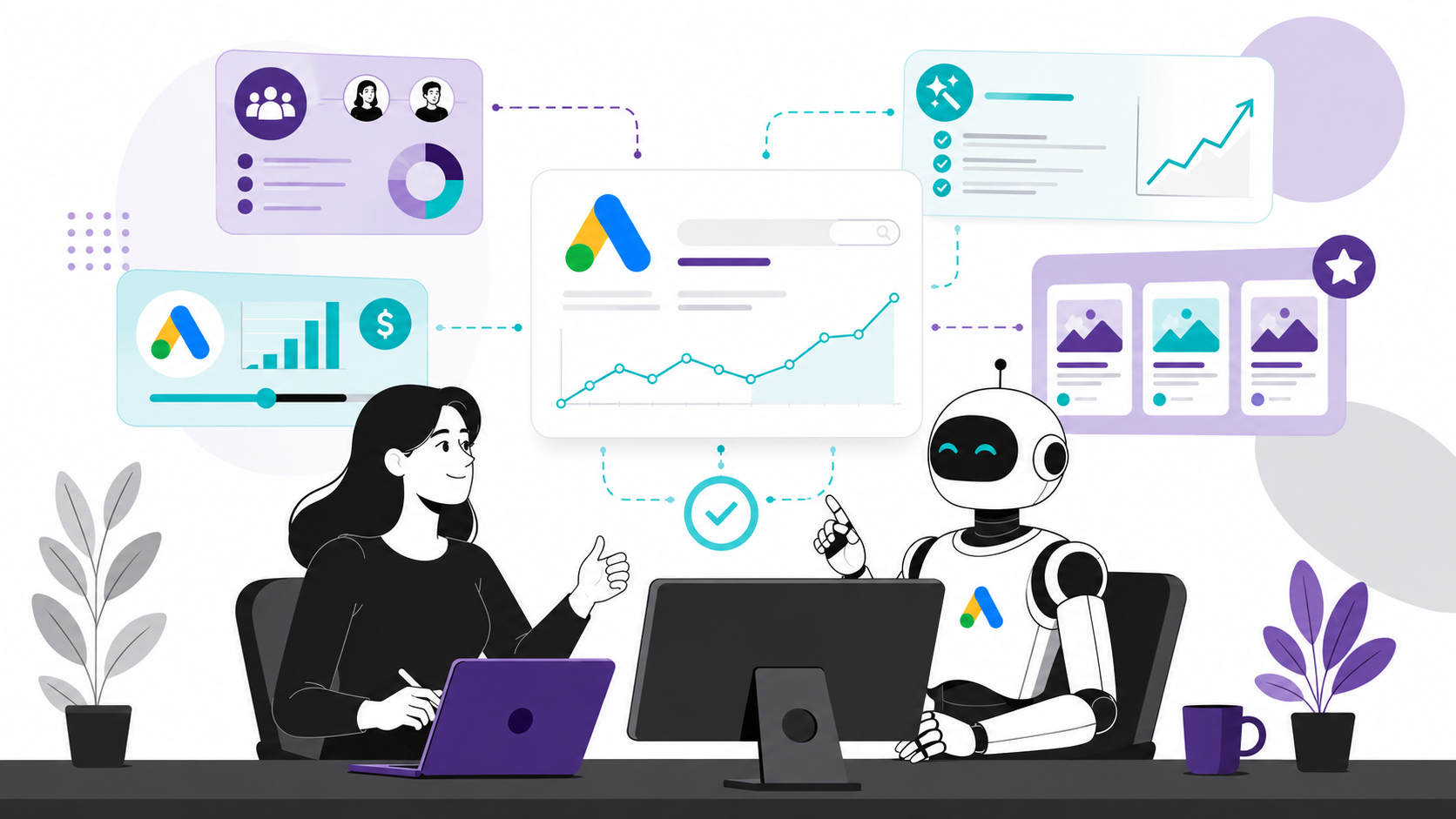
AI is rapidly reshaping how Google Ads works; features such as AI Max, Smart Bidding, Demand Gen and AI-powered search experiences are moving the platform away from manual campaign management and towards automation driven by customer intent, data and machine learning.
Google’s direction is becoming increasingly clear: AI is becoming the standard way Google Ads operates.
For businesses, this represents more than just a platform update. It changes what drives advertising success. Rather than relying solely on manual keyword optimisation or bid adjustments, advertisers are now being rewarded for providing Google’s AI with high-quality data, relevant website content, compelling creative assets and accurate measurement.
While AI offers significant opportunities to improve campaign performance and efficiency, it is not a replacement for strategic thinking. The businesses that achieve the strongest results will be those that combine automation with quality marketing foundations and ongoing human oversight.
Blog In a Snapshot
In this article, we’ll cover:
- How AI is changing the way Google Ads works
- What AI Max is and how its key features benefit advertisers
- Why better data and measurement are becoming a competitive advantage
- Where AI still requires human strategy and oversight
- What Google’s AI direction means for the future of digital advertising
Search is Moving from Keywords to Customer Intent
For many years, Google Ads campaigns were built around carefully selected keywords. Advertisers manually chose search terms, wrote individual ads and directed users to specific landing pages.
That model is steadily evolving.
Google’s AI now evaluates much more than keywords alone. It considers search intent, historical conversion data, user behaviour, landing page relevance, website content and creative assets to determine when and where ads should appear.
Rather than asking whether someone searched for an exact phrase, Google’s AI is increasingly asking what problem that person is trying to solve.
For advertisers, this means keyword research remains important, but its role is changing. Instead of focusing exclusively on exact-match phrases, businesses need to understand customer intent and ensure their website content answers the questions users are actually asking.
Well-structured service pages, helpful content and clear messaging provide stronger signals to Google’s AI than keyword targeting alone.
How AI Max Works & Why It Matters
One of Google’s biggest recent developments is AI Max, an enhancement for Search campaigns that uses AI to improve targeting, ad creation and landing page selection automatically. Rather than introducing an entirely new campaign type, AI Max strengthens existing Search campaigns by helping Google better understand customer intent.
Its three core capabilities demonstrate how Google Ads is becoming increasingly automated.
Smarter Search Matching
How it works: Instead of relying only on exact keywords, AI Max analyses the intent behind a user’s search to identify additional relevant search queries.
Benefits: This allows businesses to reach more qualified customers without continually expanding keyword lists manually.
For example, imagine you’re advertising running shoes.
Without AI Max, someone searching for “best marathon shoes for flat feet” may never see your advertisement because the search doesn’t exactly match your chosen keywords.
With AI Max, Google understands the user’s intent and can:
- Show your ad
- Generate more relevant ad copy
- Direct the user straight to your marathon shoes landing page
Rather than matching words, AI is matching customer intent, creating a more relevant experience for both advertisers and users.
AI-Generated Ads
How it works: AI Max automatically creates headlines and descriptions using your existing assets, website content and the context of each individual search.
Benefit: Ads become more relevant to individual users without marketers needing to manually write dozens of ad variations. It also allows campaigns to adapt more efficiently as search behaviour evolves.
Smart Landing Page Selection
How it works: Instead of always directing users to a single landing page, AI Max can identify the page on your website that best matches a customer’s search intent.
Benefit: A more relevant landing page creates a better user experience and increases the likelihood of conversion by reducing friction between the search and the destination.
Better Data is Becoming The Competitive Advantage
One of Google’s strongest messages throughout its AI announcements is simple: AI is only as good as the data it receives.
As more campaign decisions become automated, accurate measurement is becoming one of the biggest competitive advantages available to advertisers.
Google recommends businesses implement:
- Google Tag
- Enhanced Conversions
- Google Analytics 4
- Customer Match
- Google Tag Gateway
These tools provide Google’s AI with stronger conversion signals, allowing bidding strategies and campaign optimisation to become more accurate over time.
Google Tag Gateway: Better measurement for better AI
One of the most significant, yet often overlooked, developments is Google Tag Gateway.
As browser privacy restrictions continue to evolve, websites are losing valuable conversion data that previously helped optimise advertising campaigns.
Google Tag Gateway allows Google Ads and GA4 tracking tags to be served directly from your own website domain rather than Google’s. Because browsers recognise these as first-party requests, tracking becomes more reliable despite increasing privacy restrictions.
For advertisers, this can lead to:
- More accurate conversion tracking
- Better reporting
- Stronger optimisation signals for Google’s AI
This reinforces an important shift in digital marketing. Measurement is no longer simply an analytics exercise, it directly influences advertising performance.
AI Improves Efficiency, But Strategy Drives Results
One common misconception is that AI removes the need for experienced marketers.
In reality, automation changes where expertise is applied.
AI can generate ad copy, recommend audiences, optimise bids and select landing pages, but it cannot define your competitive positioning, develop your brand messaging or understand your commercial priorities.
Businesses should continue investing in:
- High-quality website content
- Clear value propositions
- Strong creative assets
- Well-designed landing pages
- Consistent brand messaging
AI enhances strong marketing foundations. It does not replace them.
Demand Gen: Google’s Move Towards Full-Funnel Marketing
Google is also encouraging advertisers to think beyond traditional Search campaigns.
Demand Gen allows businesses to reach potential customers before they actively search, placing ads across YouTube, Shorts, Gmail, Discover and Maps. The presentation highlights that a significant proportion of Demand Gen conversions come from users who had not interacted with Search ads in the previous 30 days, demonstrating its ability to generate demand rather than simply capture existing demand.
This reflects a broader strategic shift.
Businesses relying solely on Search campaigns may eventually encounter:
- Increasing competition
- Higher cost-per-clicks
- Slower growth as existing search demand becomes saturated
A full-funnel strategy that combines Search, Demand Gen, SEO, content marketing and remarketing creates more opportunities to engage customers throughout their buying journey.
Rather than viewing paid advertising, organic search and content marketing as separate disciplines, businesses should think about how they work together to build sustainable growth.
AI is Powerful, But Still Needs Human Guidance
Although Google’s AI capabilities continue to improve, they are not yet at a point where campaigns can simply be left to run without oversight.
Like any intelligent system, AI performs best when guided by quality inputs and ongoing strategic direction.
- AI is only as effective as the data it receives: Accurate tracking, quality website content and strong creative assets give Google’s AI better signals to optimise campaigns.
- Automation still requires human oversight: AI Max can uncover new opportunities, but campaigns should be monitored to ensure traffic remains relevant and aligned with business goals.
- Strategy remains the differentiator: AI can automate tasks, but it can’t replace human insight, brand positioning or a well-designed customer journey.
Final Thoughts: The Future of Google Ads is Guided by AI, But Powered by Strategy
Google’s direction is becoming increasingly clear: AI is becoming the standard way Google Ads operates.
Search is moving from keyword targeting towards understanding customer intent, while features like AI Max and Demand Gen reflect a broader shift towards automation and full-funnel marketing.
Rather than relying solely on Search campaigns, businesses are being encouraged to engage customers throughout the entire buying journey.
At the same time, the role of marketers is evolving. As AI takes over more repetitive campaign tasks, such as bid optimisation, ad generation and landing page selection, success will depend less on manual campaign management and more on providing AI with the right foundations. Accurate measurement, strong first-party data, high-quality creative assets, valuable website content and well-designed customer journeys will become increasingly important.
The future of Google Ads isn’t about replacing marketers with automation. It’s about allowing marketers to focus on strategy, creativity and building connected digital experiences that help AI perform at its best.
If you’re reviewing your Google Ads strategy, it’s worth looking beyond campaign settings alone. Your measurement, website, creative assets and customer journey are becoming increasingly interconnected, and strengthening those foundations today will better position your business as Google’s AI capabilities continue to evolve.