
Many brands struggle with differentiation.
In saturated markets, businesses often offer similar products, similar pricing, and similar promises. The deciding factor often becomes how the brand is perceived by customers. This is where brand personality moves from a creative consideration to a commercial one too.
The previous thinking around tactics, such as emoji usage, focused on engagement in isolation. While that still has a place, it misses the broader point. Personality isn’t simply about entertaining or sounding more “human” in a single channel. Rather, it’s a system that shapes how your brand communicates, behaves, and converts across the entire customer journey.
This blog reframes the conversation; rather than asking whether you should use emojis in marketing, the more useful question is how you build a brand personality that improves performance, and how to execute it consistently across channels, including AI-driven content.
Why Does Brand Personality Matter?
Brand personality directly influences how people engage with your business.
It impacts:
- Click-through rates in ads
- Engagement across social and content
- Conversion rates through trust and relatability
- Customer retention and long-term loyalty
As content volume increases, particularly with AI-generated output, sameness becomes the default. Many brands are now technically consistent, but strategically indistinguishable.
Personality becomes the differentiator.
It is not about being louder or more creative. It is about being recognisable, consistent, and aligned with how your business actually operates.
How Is Brand Personality Built?
A common mistake is treating personality as a tone decision, for example choosing to sound “fun” or “quirky”.
Effective brand personality is built from:
- Brand values
- Market positioning
- Audience expectations
- The actual customer experience you deliver
If these elements aren’t aligned, personality becomes surface-level. It may improve short-term engagement, but it will not hold under pressure across paid media, SEO content, or conversion journeys.
A strong personality should feel consistent whether someone:
- Sees a Google ad
- Reads a blog
- Receives an email
- Interacts with customer support
This is where most businesses fall short. They optimise channels individually rather than building a connected communication system.
Building a Consistent Brand Voice Framework
Consistency is what turns personality into an asset rather than a risk.
At a minimum, brands should define:
- Tone of voice guidelines
- Messaging principles
- Language rules, including what to avoid
Without this, content becomes reactive. Different team members, agencies, or AI tools produce slightly different outputs, which weakens trust over time.
From an SEO perspective, consistency improves content quality signals and brand recognition. From a paid media perspective, it improves ad relevance and click-through rates. From a conversion standpoint, it reduces friction because the experience feels cohesive.
Use Customer Language, Not Internal Language
One of the fastest ways to strengthen brand personality is to remove internal jargon.
High-performing brands use:
- Language from customer reviews
- Phrasing from sales calls
- Common objections and questions
This does two things:
- Improves clarity, which directly impacts conversion
- Grounds personality in reality, rather than creative interpretation
It also strengthens performance across SEO and paid channels, where alignment with search intent and user expectations is critical.
Personality Is Experienced, Not Just Written
Most discussions around personality focus on copywriting. In practice, customers experience personality through behaviour.
This includes:
- Response times
- Email communication style
- Post-purchase interactions
- How issues are handled
For example, a brand that positions itself as approachable but has slow, transactional support undermines its own messaging.
From a systems perspective, personality must carry through:
- Ads
- Landing pages
- CRM and automation flows
- Ongoing customer communication
This is where automation becomes relevant. Personalisation at scale is only effective if the underlying voice is consistent. Otherwise, automation amplifies inconsistency.
Where Tactics Like Emojis Fit In
Emojis are not inherently good or bad. They are simply a tool.
Used correctly, they can:
- Add tone to otherwise flat text
- Improve readability in certain contexts
- Increase engagement in informal channels
Used incorrectly, they can:
- Undermine credibility
- Confuse messaging
- Create inconsistency across touchpoints
The key is context.
For example:
- In social media or B2C email campaigns, emojis may support tone
- In professional services, they may be limited to specific moments or avoided entirely
The decision should not be based on trends, but on whether it aligns with your defined brand personality.
If your brand does not have a clearly defined voice, adding emojis will not solve the underlying issue.
How Do You Balance Personality With Clarity?
A common overcorrection is leaning too far into personality at the expense of clarity.
This shows up as:
- Overly casual messaging that lacks direction
- Creative phrasing that obscures meaning
- Inconsistent tone across channels
The goal is not to be different for the sake of it.
The goal is to be:
- Distinct but still clear
- Human but still structured
- Recognisable without sacrificing understanding
From a conversion perspective, clarity is non-negotiable. Personality should support comprehension, not compete with it.
Adapting Tone Across Channels Without Losing Identity
Different platforms require different execution styles.
For example:
- LinkedIn tends to reward structured, insight-led content
- Instagram allows for more conversational tone
- Email requires direct, value-led communication
However, the underlying personality should remain consistent.
This is particularly important when integrating:
- SEO content for discoverability
- Paid media for acquisition
- Email and automation for nurturing
If each channel feels like a different brand, performance suffers across the funnel.
AI and the Risk of Generic Brand Voice
AI has made it significantly easier to produce content, but with this, it has also introduced a new problem, exposing when a brand doesn’t have a defined personality.
Without clear inputs, AI produces:
- Structurally correct content
- Neutral, widely accepted language
- Outputs that could belong to any brand
This is why many businesses now sound the same. AI is not the issue; the lack of strategic direction is.
AI should be treated as an amplifier, not a replacement. If your inputs are generic, your outputs will be too.
How to Use AI Without Losing Brand Personality
To maintain differentiation while scaling content, businesses should:
1. Start With a Defined Brand Voice: Document tone attributes, messaging rules, and examples. This becomes the foundation for all AI-assisted content.
2. Prompt With Context:
Each prompt should include details of:
- Who the audience is
- What they care about
- Where they are in the funnel
- What the outcome should be
Doing so shifts AI from generic output to aligned execution.
3. Treat AI Output as a Draft: AI should accelerate production, not replace judgement. Every piece should be refined for tone, clarity, and alignment.
4. Inject Real Customer Language: Ground content in real inputs such as reviews, FAQs, and sales conversations. This is what makes content feel specific rather than templated.
5. Align Across the Full Customer Journey: Ensure consistency across ads, website, email, and content. Personality should not change between touchpoints.
Common Mistakes to Avoid
Several patterns consistently weaken brand personality:
- Confusing visual identity with personality
- Copying competitor tone rather than defining your own
- Overusing tactics like emojis without strategic context
- Lacking documented voice guidelines
- Inconsistent messaging across channels
- Relying on AI without refinement
Each of these reduces trust and makes the brand less memorable.
Our Recommendation To Avoid Sounding Generic: Branded Custom-GPT
For brands producing content at scale, one of the more effective ways to maintain consistency is to build a structured AI layer around your brand.
This is where custom GPTs become relevant.
Rather than starting from scratch each time, a custom GPT allows you to embed:
- Brand voice guidelines
- Messaging principles
- Audience context
- Content frameworks
This creates a controlled environment where AI outputs are aligned by default, not corrected after the fact.
It shifts AI from a reactive tool to a systemised part of your marketing execution.
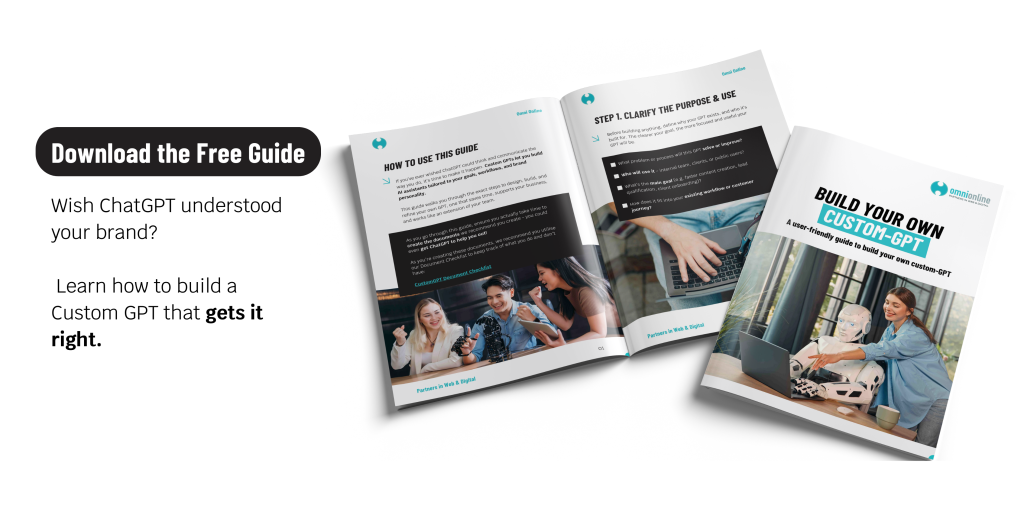
If you’re exploring this direction, we’ve outlined the process in detail in our guide to building your own custom GPT, including how to structure inputs, define tone, and ensure outputs remain commercially aligned.
Final Thoughts
Brand personality is not about sounding different for the sake of it.
It is about building a consistent, recognisable experience across every interaction, from first click to post-purchase communication.
Tactics like emojis can support this, but they are not the strategy. Without a defined system behind them, they add noise rather than value.
As content becomes easier to produce, differentiation becomes harder to maintain. Personality is no longer optional. It is a core driver of performance across SEO, paid media, and conversion.
If your current content could belong to any competitor, that is the signal to step back and reassess the system behind it.
A practical next step is to review your existing touchpoints and ask a simple question: does this feel like the same brand at every stage?