It’s common to see businesses investing heavily in digital marketing, SEO, paid ads, content, and social, yet struggling to translate that activity into consistent revenue growth.
At the same time, some businesses focus on improving retention, product experience, or pricing, but fail to scale because demand isn’t keeping up.
Neither side is wrong. They’re incomplete.
Understanding digital marketing vs growth isn’t about choosing one over the other. It’s about recognising how they operate at different levels of the same system, and why both are required to scale sustainably.
Blog in a snapshot
In this article, we’ll cover:
- The real difference between marketing and growth
- What each function is responsible for across the business
- Why traffic and campaigns don’t guarantee revenue
- How growth extends beyond acquisition into retention and expansion
- What to measure if you care about long-term performance
Marketing vs Growth: The Core Difference
At a strategic level:
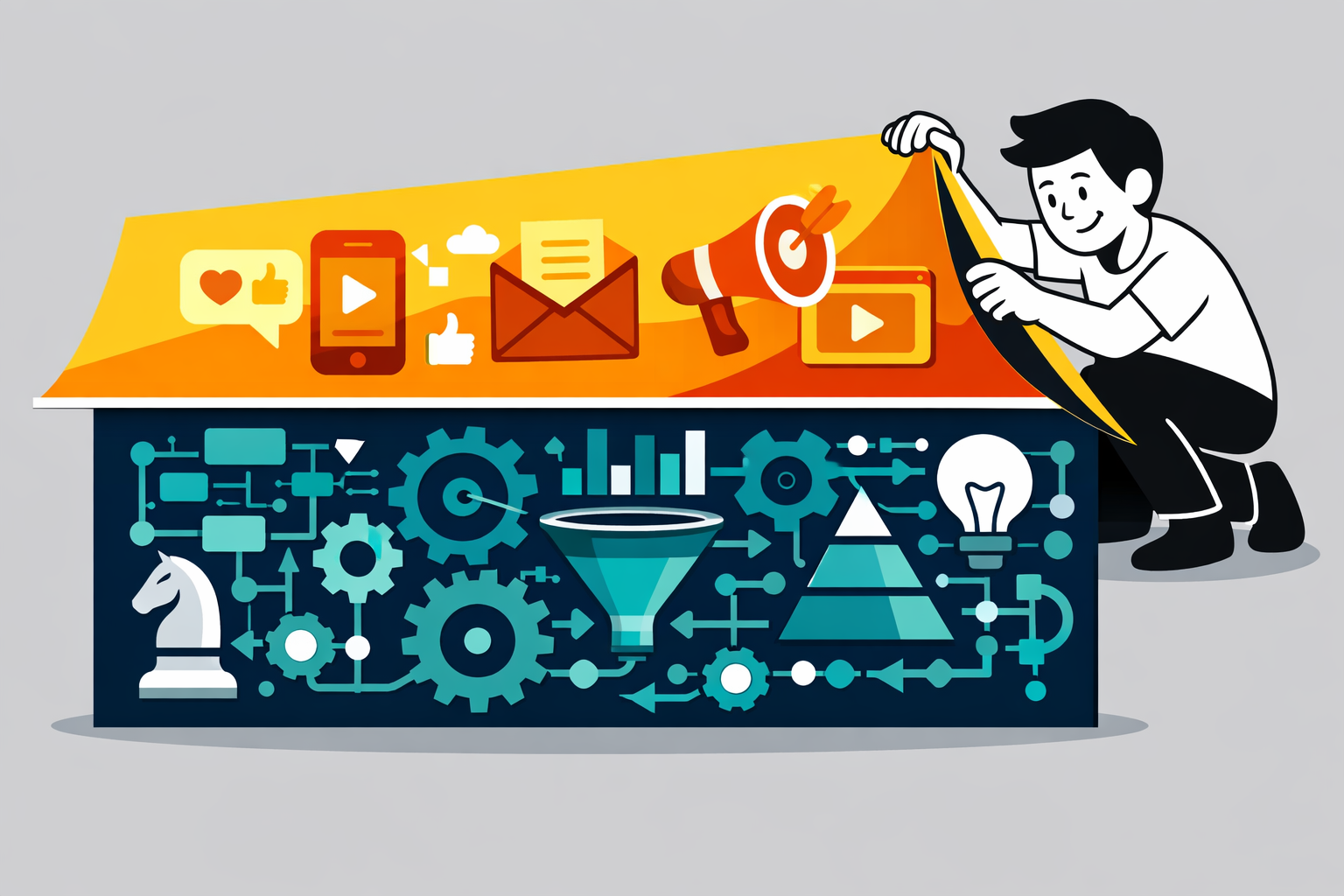
- Marketing focuses on generating attention, trust, and demand
- Growth focuses on turning that demand into efficient, scalable revenue
Marketing plays a critical role before and during acquisition. It shapes perception, positions the offer, and brings the right people into the business.
Growth builds on that foundation. It connects acquisition to what happens next, conversion, retention, repeat purchase, and referral.
A useful way to think about it:
- Marketing fills the funnel
- Growth ensures the funnel actually works
Importantly, this doesn’t mean marketing stops at the top of funnel. Strong marketing influences conversion and even retention through messaging, expectation setting, and brand trust. But on its own, it cannot fix structural inefficiencies deeper in the system.
Side-by-Side Comparison
| Area | Digital Marketing | Growth |
| Primary Focus | Generating attention, demand, and trust | Turning demand into efficient, scalable revenue |
| Role in the Business | Brings new users into the system | Optimises how users convert, return, and expand |
| Scope | Channel-driven (SEO, ads, content, social) | System-driven (entire customer lifecycle) |
| Core Objective | Drive awareness and acquisition | Improve revenue efficiency and compounding growth |
| Where It Operates | Pre-purchase and early journey influence | Across acquisition, activation, retention, and referral |
| Structure | Campaigns and channel execution | Systems, loops, and lifecycle optimisation |
| Key Levers | Messaging, targeting, creative, channels | Onboarding, retention, pricing, referrals |
| Mindset | Increase and improve inputs | Improve how inputs perform over time |
| Success Indicators | Traffic, leads, CAC, engagement | Retention, LTV, revenue growth, referral rate |
| Common Pitfalls | Activity without meaningful outcomes | Efficiency without scale |
What Each Function Is Designed to Do
The distinction becomes clearer when you look at purpose.
Marketing is responsible for:
- Creating awareness and visibility
- Helping people understand the offer
- Generating interest and qualified demand
This includes:
- Brand positioning and messaging
- SEO, paid media, content, and social
- Campaign strategy and creative
Growth is responsible for:
- Driving revenue efficiency over time
- Improving how customers convert and return
- Building systems that compound
This includes:
- Onboarding and activation
- Retention and churn reduction
- Referral and word-of-mouth systems
- Pricing, packaging, and upsell strategy
The key shift is this:
- Marketing focuses on attention
- Growth focuses on efficiency and scalability
Why Marketing Performance Doesn’t Always Lead to Growth
One of the most common challenges is strong marketing performance paired with weak business outcomes.
You might see:
- Increasing traffic
- Improving ad performance
- Consistent content output
But still experience:
- Low conversion rates
- Poor retention
- Flat revenue
This happens when marketing is optimised at the channel level, but the system behind it is not.
Marketing can bring the right people in, but if onboarding is unclear, the offer is misaligned, or the experience creates friction, growth stalls.
This is where many businesses misdiagnose the problem and increase spend, when the real issue sits in conversion or retention.
Why Growth Still Depends on Marketing
The opposite scenario is just as limiting.
A business may have:
- Strong retention
- A solid product or service experience
- Effective upsell or expansion strategies
But struggle with:
- Inconsistent lead flow
- Limited reach
- Slow acquisition
Without marketing, there is no scalable way to generate demand.
Growth systems rely on input. Marketing provides that input.
From Funnels to Systems and Loops
Another important distinction is how each function approaches scale.
Marketing traditionally operates in funnels:
Awareness, Consideration, and Conversion
Growth expands this into a broader system:
Acquisition, Activation, Retention, Referral, and Expansion
This introduces compounding effects.
For example:
- Retention improves lifetime value
- Satisfied customers drive referrals
- Referrals reduce acquisition costs
This is where growth shifts from linear thinking to loop-based thinking. Instead of constantly needing more traffic, the system becomes more efficient over time.
What Should You Focus On?
Marketing priorities
- Define a clear market position
- Build messaging for a specific audience
- Align content to real problems, not assumptions
- Continuously test channels, audiences, and creative
Growth priorities
- Map the full customer journey
- Identify where users drop off
- Improve activation and early experience
- Strengthen retention and repeat behaviour
- Build referral mechanisms intentionally
- Treat pricing and offers as growth levers
The distinction is simple but important:
- Marketing improves the inputs
- Growth improves how those inputs perform over time
What to Measure
The difference also shows up in metrics.
Marketing metrics focus on entry into the system:
- Customer acquisition cost (CAC)
- Traffic and lead volume
- Brand awareness and recall
- Initial conversion rates
Growth metrics focus on value over time:
- Activation rate
- Retention (Day 7, Day 30, etc.)
- Revenue retention
- Referral rate
- Time to value
A business can improve acquisition metrics while overall growth remains flat. That gap is where strategic attention is needed.
Common Mistakes
Across both areas, a few patterns consistently limit performance:
Marketing-side mistakes:
- Measuring reach without tying it to revenue
- Driving traffic without a clear conversion path
- Prioritising output over performance
- Optimising for clicks instead of outcomes
Growth-side mistakes:
- Scaling acquisition before fixing retention
- Treating churn as secondary
- Assuming referrals will happen naturally
- Using traffic as a proxy for success
Final Thoughts
Digital marketing and growth are not competing priorities. They are interdependent.
Marketing builds awareness, trust, and demand across the market. Growth ensures that demand converts, retains, and compounds into sustainable revenue.
If marketing operates without growth, it creates activity without meaningful outcomes. If growth operates without marketing, it limits scale by restricting demand.
The businesses that scale effectively are those that connect both into a single system, where acquisition, experience, and retention are aligned.