As we move into the second half of the year, many businesses find themselves asking the same question:
Are our marketing efforts actually producing the growth we expected?
When growth slows, many businesses respond in predictable ways. They launch new campaigns, increase advertising spend, publish more content, or start testing new channels.
The assumption is simple: if results are slowing, we need to do more and invest more into marketing.
The problem is that more activity rarely generates results if we cannot identify where the root problem is.
At Omni, we’ve found that most growth challenges can be traced back to one of three bottlenecks:
- People don’t know that your brand exists.
- People aren’t purchasing from your brand.
- People aren’t coming back to your brand.
Before investing more into marketing, it’s worth asking a different question:
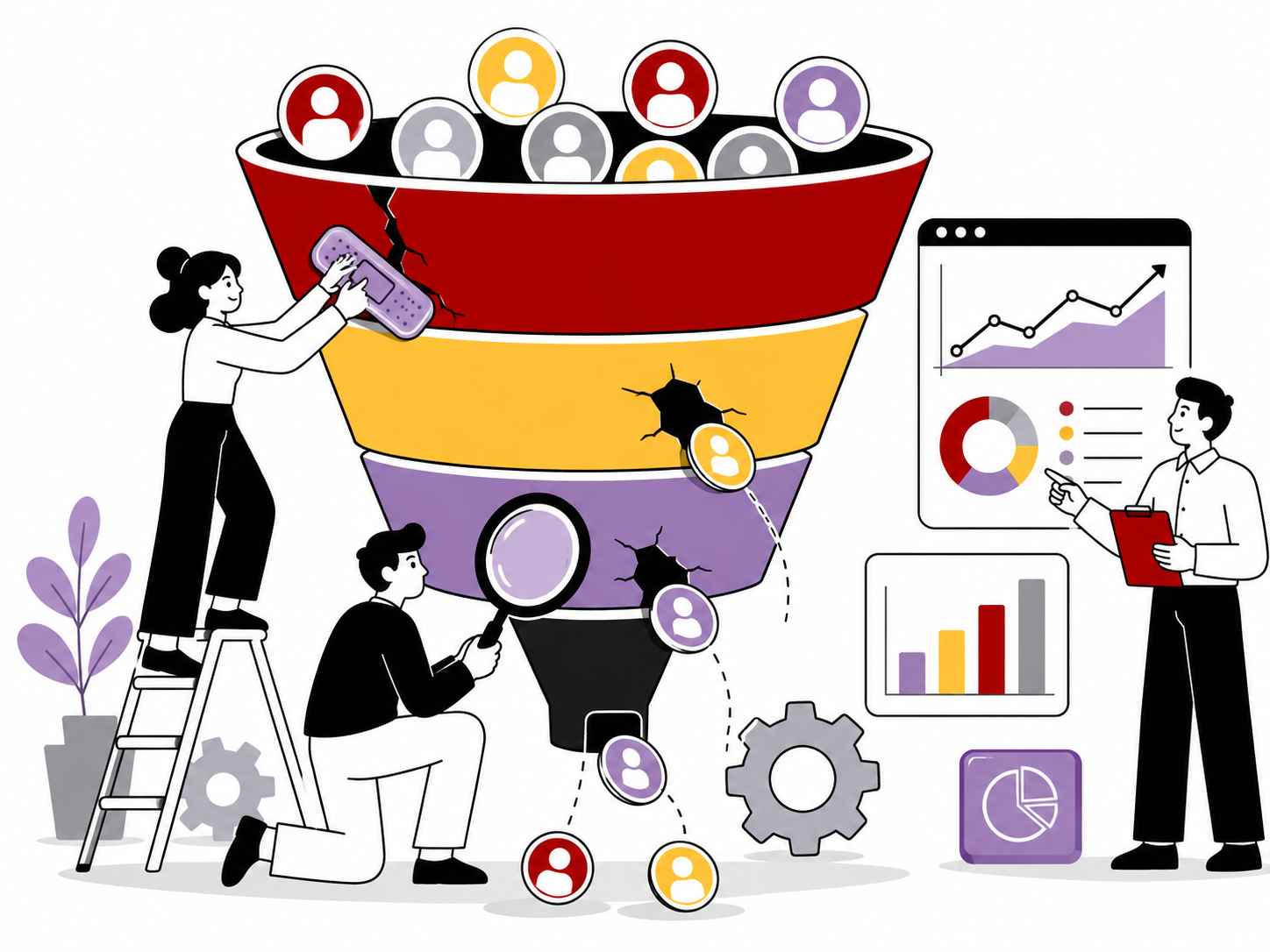
Where is growth leaking?
Conducting a mid-year growth audit provides an opportunity to step back and identify which of these areas is limiting performance before investing additional time, budget, and resources.
Because fixing the wrong problem is often more expensive than fixing no problem at all.
Blog in a Snapshot
- Growth problems are usually caused by a constraint, not a lack of effort
- Most bottlenecks sit within Attract, Activate, or Return
- More marketing won’t fix the wrong part of the system
- Identify where growth is leaking before increasing advertising spend
- The biggest opportunity is often your weakest growth pillar
- Sustainable growth comes from strengthening the system, not chasing tactics.
Why More Marketing Doesn’t Always Create More Growth
One of the biggest mistakes businesses make when growth slows is assuming they have a marketing problem.
Traffic is down, so they invest in more advertising.
Lead volume drops, so they launch another campaign.
Sales plateau, so they increase activity across every channel.
Sometimes that’s the right move. Often, it’s not.
Because growth doesn’t usually stall due to a lack of effort. It stalls because there’s a bottleneck somewhere in the system.
Imagine a business generating thousands of website visitors every month but converting very few into enquiries. More traffic won’t solve that problem. It will simply increase the number of people leaving without taking action.
The same applies to retention. If customers aren’t returning, increasing acquisition spend may grow revenue temporarily, but it also increases the cost of replacing customers who were never retained in the first place.
This is why sustainable growth isn’t about doing more marketing. It’s about identifying where the journey is breaking down and strengthening that part of the system first.
The Omni 360° Growth Model
At Omni, we simplify growth into three interconnected pillars:
Attract: Be Found
People need to know your brand exists.
Activate: Be Chosen
People need a reason to trust you and buy from you.
Return: Be Remembered
People need a reason to come back, refer others, and continue engaging with your brand.
Every growth challenge typically originates in one of these areas.
The key is identifying which one is currently limiting performance.
Pillar One: Attract (Be Found)
If the right people can’t find your business, everything else becomes harder.
You can have a strong product, competitive pricing, and a great customer experience, but none of it matters if potential customers never discover you.
Common bottlenecks within the Attract layer include:
- Weak organic visibility
- Over-reliance on paid advertising
- Poor positioning
- Limited brand awareness
- Inconsistent content and discoverability
One of the clearest warning signs is when visibility disappears the moment advertising stops.
Paid media can be an effective growth lever, but when it’s your only source of visibility, growth becomes dependent on ongoing spend rather than building long-term demand.
Ask yourself:
Could the right buyer find us without an ad?
If the answer is no, Attract may be your biggest constraint.
Pillar Two: Activate (Be Chosen)
Getting attention is only half the equation.
The next question is whether people choose you once they find you.
Many businesses generate website traffic, enquiries, and even qualified leads, yet struggle to consistently convert that interest into revenue.
This is often an Activate problem.
Common Activate bottlenecks include:
- Unclear value propositions
- Weak trust signals
- Poor conversion pathways
- Limited social proof
- Friction in the buying process
One of the biggest misconceptions in marketing is that conversion requires more persuasion.
In reality, most prospects don’t need more convincing. They need more clarity.
They need to understand:
- Why your solution matters
- Why they should trust your business
- What happens next
When those elements are missing, prospects hesitate.
Not because they aren’t interested, but because they haven’t built enough confidence to act.
Pillar Three: Return (Be Remembered)
This is often the most overlooked stage of growth.
Many businesses invest heavily in attracting and converting customers but stop thinking about the relationship once a sale occurs.
The result?
Growth becomes expensive.
Every month starts from zero.
Customer acquisition costs increase.
Revenue becomes less predictable.
A strong Return system focuses on:
- Retention
- Loyalty
- Reviews
- Referrals
- Ongoing nurture
When customers return, the economics of growth improve.
Revenue compounds.
Marketing becomes more efficient.
Growth becomes more stable.
If you’re constantly chasing new customers just to maintain revenue, Return may be the constraint limiting your ability to scale.
The Mid-Year Growth Audit Most Businesses Never Run
As we move into the second half of the year, here’s a simple way to identify your biggest bottleneck.
Ask yourself which statement feels most true right now:
1) People Don’t Know We Exist
You likely have an Attract problem.
Review:
- Organic visibility
- Brand awareness
- Search performance
- Traffic sources
- Dependence on paid media
2) People Aren’t Purchasing
You likely have an Activate problem.
Review:
- Conversion rates
- Lead-to-sale performance
- Website messaging
- Trust signals
- Customer experience
3) People Aren’t Coming Back
You likely have a Return problem.
Review:
- Repeat purchase rate
- Customer retention
- Lifetime value
- Reviews and referrals
- Email engagement
The goal isn’t to improve everything at once.
The goal is to identify the constraint and strengthen the part of the system that is limiting everything else.
Growth Comes From Fixing the Right Problem
One of the most expensive mistakes businesses make is optimising the wrong lever.
They invest in more traffic when conversion is the issue.
They redesign websites when visibility is the issue.
They increase acquisition budgets when retention is the issue.
All of those activities can look productive. None of them create sustainable growth if they don’t address the underlying constraint.
The businesses that grow consistently aren’t always the ones doing the most marketing.
They’re the ones that understand where growth is leaking and fix it first.
Before increasing your budget, launching another campaign, or adding another channel, take a step back and ask:
Is the problem really a lack of marketing, or are you fixing the wrong part of the system?
The answer could save you a significant amount of time, budget, and effort in the months ahead.
The first step isn’t doing more, it’s understanding what needs to be fixed first. Book a complimentary 360° Growth Strategy Call and we’ll help you identify the constraint that’s limiting sustainable growth.