What Are All The Changes Happening To Google Ads In The Age Of AI?
Many businesses approach Google Ads with the wrong expectations.
They treat it like a social media advertising platform, focusing heavily on creatives, broad audiences, and brand visibility…but that approach often leads to disappointing results.
Google Ads operates on a fundamentally different principle, while platforms like Meta focus on interruption and discovery, Google Ads is built around intent. People use Google when they’re actively searching for something. That difference changes how campaigns should be structured, how success is measured, and how advertising budgets should be allocated.
When businesses misunderstand this distinction, they often spend heavily without capturing the opportunities that Google Ads is designed to provide.
Understanding how platforms work, and how it fits within a broader digital marketing strategy, is what separates campaigns that generate consistent leads or sales from those that simply burn through budget.
Blog In A Snapshot
In this blog, we cover the fundamentals of how Google Ads works and how businesses can approach the platform more strategically.
Specifically, we’ll walk through:
- What Google Ads is and how the advertising system works
- Why search advertising is built around user intent
- The different campaign types available, including search, display, shopping, and YouTub
- The key components of a Google search ad
- How targeting, bids, and quality score influence ad visibility
- The practical questions businesses should ask before investing in Google Ads
How Do Google Ads Work?
Google Ads works on an auction system, which takes place every time a user performs a keyword search.
The Google Ads auction is focused around keywords, where advertisers choose a list of keywords to target that are relevant to their business offerings, the words that people are most likely to use when searching for their product. Businesses then bid on those keywords, which represent the amount they’re willing to pay when someone clicks on their ad.
Why use Google Search Ads?
The beauty of Google ads is that when people go to Google, they’re looking for something specific and typically have a clear purpose.
They may be researching, comparing options, or actively looking to purchase a product or service. This means their search reflects a form of intent.
By targeting relevant keywords, businesses can present their products or services to people who are already expressing interest in that category. In other words, users are literally telling you what they want to buy by typing out words around your products and services.
For businesses focused on generating leads or sales, this makes Google Ads a valuable channel for reaching potential customers at the moment of intent.
How AI Has Changed Google Ads
Google Ads is increasingly driven by AI.
In the past, advertisers manually selected keywords, placements, and bidding strategies. While those elements still exist, much of the optimisation now happens through machine learning.
Google’s AI analyses signals such as search behaviour, audience intent, device usage, location, and previous interactions. It then uses that data to determine when ads should appear, which creative variation should be shown, and how budgets should be allocated.
This shift means the role of the advertiser has also evolved.Rather than controlling every setting manually, the focus has moved toward:
- Providing high-quality creative assets
- Supplying strong audience and conversion signals
- Structuring campaigns around clear goals
Google’s AI then uses this information to test variations and identify patterns that improve performance over time.
Where AI Appears Inside Google Ads
AI now influences multiple layers of a Google Ads account.
Campaign optimisation: Campaign types such as Performance Max and Demand Gen use AI to distribute ads across Google’s ecosystem, including Search, YouTube, Display, Discover, Gmail, and Maps.
Audience discovery: Machine learning analyses behaviour signals to identify users who show intent to purchase, even if they do not match traditional targeting parameters.
Creative testing: Google automatically tests combinations of headlines, descriptions, images, and videos to determine which variation performs best for each search or audience segment.
Budget and bidding decisions: AI can adjust bids and allocate budget based on predicted conversion likelihood, helping campaigns prioritise higher-value opportunities.
Type of Google Ads Campaigns (Including AI-Powered Campaigns)
Today, many Google Ads campaigns are powered by machine learning.
While traditional formats like Search and Display still exist, newer campaign types such as Performance Max and Demand Gen rely heavily on AI to determine targeting, placements, and creative combinations.
1. Search Campaigns: display ads directly within Google search results.
- Targeting: Keyword-based targeting
- Ad types:
- Expanded Search Ads
- Dynamic Search Ads
- Responsive Search Ads
These ads appear when someone searches for keywords related to your products or services.
2. Display Campaigns: place visual ads across websites, apps, and platforms that are part of the Google Display Network.
- Targeting: unlike search campaigns, display campaigns don’t rely on keywords alone. Targeting can include:
- User interests and intent
- Website visitors (remarketing)
- Demographics
- Website placements
- Ad types:
- Static banner ads
- Video ads
- Dynamic ads
- Responsive Display Ads
- Uploaded Display Image Ads

Display campaigns are typically used to build awareness, re-engage previous visitors, or reach audiences earlier in the buying journey.
3. Shopping Campaigns: commonly used by eCommerce businesses.
Instead of relying on keywords alone, these ads use product data from your Google Merchant Center feed. The platform matches product attributes such as titles, descriptions, and categories with relevant searches.
- Targeting: product attributes from the Merchant Center data feed
- Ad types
- Shopping ads

These ad types typically appear at the top of Google search results with product images, prices, and store information.
4. Youtube Campaigns: allow businesses to advertise through video across the YoutTube platform.
- Targeting:
- Audience interests and intent
- Previous website visitors
- Demographics
- Youtube channel or video placements
- Ad types
- Skippable video ads
- Non-skippable video ads
- Bumper ads
- Overlay ads
- In-feed video ads
- Shorts ads

Video advertising is often used to build brand awareness or engage audiences with visual storytelling.
5. Performance Max Campaigns (AI-Powered)
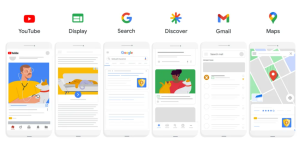
Performance Max campaigns allow advertisers to run ads across multiple Google platforms from a single campaign. Google’s AI uses signals such as user intent, audience behaviour, and website data to find potential customers across the ecosystem.
- Ads can appear across:
- Search
- Display
- Youtube
- Discover
- Gmail
- Maps
- Targeting: AI-driven targeting using audience signals, intent data, and website behaviour
- Ad types
- Text ads
- Image ads
- Video ads
- Shopping ads
6. Demand Gen Campaigns (AI-Powered)
Demand Gen campaigns are designed to reach potential customers earlier in the buying journey through visually driven placements across Google’s discovery platforms.
- Ads typically appear on:
- YouTube
- Discover
- Gmail
- Targeting: Audience-based targeting using interests, demographics, and behavioural signals
- Ad types
- Image ads
- Video ads
- Carousel ads
The Main Components of a Search Ad
Search ads are made up of several key elements that influence whether someone clicks on the ad.
Headline
The headline is the most visible part of the ad; it appears in the largest text and is usually the first thing you see on a Google ad. Incorporating relevant keywords in the headline helps signal that the ad matches the user’s search intent, which can improve the CTR.
In Responsive Search Ads, advertisers can add multiple headlines and descriptions, and Google automatically tests different combinations to find the best-performing ad. Google allows up to 3 headlines, each up to 30 characters.
Descriptions
Description text helps highlight the most important details about your product or service and why search users should click through.
This is where advertisers explain the value of their offering and encourage users to click through to the website.
Google Ads allow max 90 characters.
Who Will See My Search Ads?
Search ads are shown to users who search for the keywords you target in your campaigns.
However, appearing in search results is not determined by keywords alone. Two additional factors also influence whether your ad is shown:
- Your bid for the keyword
- Your Quality Score, which reflects the relevance and quality of your ad and landing page
Google combines these factors to determine ad placement during the auction.
Do Google Ads really work?
Google Ads can be effective because they target users who are already demonstrating purchase intent.
However, success depends on several underlying factors within the business and its marketing setup.
Before launching campaigns, it is worth asking a few questions:
- Are potential customers searching on Google for the products or services you offer?
- Do your products or services have sufficient margins to cover advertising costs?
- If margins are tight, can repeat purchases or customer lifetime value justify the ad spend?
- Are your website pages optimised to convert visitors into customers?
If the answer to these questions is yes, Google Ads can become a valuable channel for generating leads or revenue.
Benefits of Google ads?
There are several practical advantages to using Google Ads as part of a digital marketing strategy:
- Performance Tracking: You can track and measure the performance data such as website visits, form submissions, and purchases
- Cost Control: Advertisers can decide how much they want to spend and adjust budgets based on performance.
- Forecasting Performance: Over time, historical campaign data can help predict future performance.
- Consistent Lead and Sales Generation: When campaigns are properly structured and optimised, Google Ads can provide a consistent flow of traffic, leads, and sales.
Running Profitable Google Ads Campaigns
Google Ads can be a powerful tool for reaching people who are actively searching for what your business offers.
However, success rarely comes from simply launching ads. Performance depends on a combination of factors, including keyword selection, ad quality, landing page experience, and ongoing optimisation.
A well-managed campaign focuses on aligning all of these elements so advertising spend translates into meaningful business results.
If you’re considering Google Ads for your business, taking the time to plan the strategy and structure carefully is often what determines long-term success.