Let us paint a picture for you.
You’ve launched a new advertising campaign, let it run for 48 hours and now you’re panicking; “why hasn’t it converted?”, “why is my ROAS so low?”…
Does this sound familiar?
The truth many brands don’t actually want to hear is that not every advert is meant to generate sales or leads immediately. While the overarching objective of a campaign is ultimately to drive revenue, some ads are specifically designed for different outcomes depending on where the customer is in their journey.
Which results in many businesses fixating on the wrong metrics, such as judging an awareness campaign purely on ROAS, while overlooking the bigger picture of what’s happening across the customer journey.
At Omni, we often help clients reframe the way they evaluate performance by aligning campaign objectives with the right KPIs.
The specific metrics you use to measure success should depend on the intent of the campaign, which shouldn’t always be direct conversion, because that ignores how the 2026 customer journey actually works.
Today, consumers move across multiple touchpoints before making a decision. They might discover your brand through social media, revisit through Google Search, join an email list, engage with retargeting ads, and only convert weeks later. That complexity means businesses need a broader way of evaluating advertising performance.
Blog In A Snapshot
In this article, we’ll cover:
- Why the customer journey matters more than ever in modern advertising
- Why customer journey-based measurement leads to better decision-making
- The KPIs that matter at each stage of the funnel
- Why ROAS alone doesn’t always tell the full story
- How AI and automation are influencing campaign optimisation
- How to interpret advertising data with more strategic context
- How to build campaigns that support long-term sustainable growth
So let’s dive into it!
Why Should Businesses Measure Advertising Across The Full Customer Journey?
If you’re skeptical, that’s completely understandable, so let us show you proof.
Recently, we partnered with a client who was pouring budget into a broken funnel.
Their ads were entirely conversion-focused, targeting customers who had never even heard of their brand yet. In other words, they were trying to sell to people who didn’t yet know, trust, or prefer them, which ultimately paved the way for wasted spend and poor results.
Here’s what we did instead: we reduced their ad spend by 14% and reallocated that budget across the full customer journey, specifically the stages which were being neglected and standing in the way of ultimately converting. Our focus shifted toward building awareness, trust, and preference first.
We developed engaging video content that told the brand’s story; who they are, their purpose, and their mission, alongside educational content that highlighted product ingredients and benefits. This approach established credibility and nurtured consumer confidence, positioning the brand above its extensive list of competitors.
The result? Within a year, that strategic reallocation of spend led to a 20% increase in ROAS and a 32% increase in MER (Marketing Efficiency Ratio), all while spending 14% less on ads.
The reason this worked is because the funnel was no longer relying on conversion campaigns alone to do all the heavy lifting.
So, What Actually Is The Customer Journey?
The customer journey represents the entire experience someone has with your brand; from the initial moment of hearing about you, right through to becoming a loyal, repeat customer.
This journey isn’t always linear. People loop, pause, disappear for a while, compare alternatives, and come back later. In many cases, they’ll interact with multiple channels before making a decision.
However, we can still break down the customer journey into five core stages:
- Awareness: They discover you for the first time
- Consideration or Education: They’re learning, comparing and weighing up their purchase options.
- Preference: Following the process of comparing you to competitors, they decide on which brand/s they prefer in the market
- Conversion: They’re ready to act; be it through buying your products or signing up to your services
- Retention or Repeat: They become loyal to your brand, and come back again, ideally telling their friends about you.
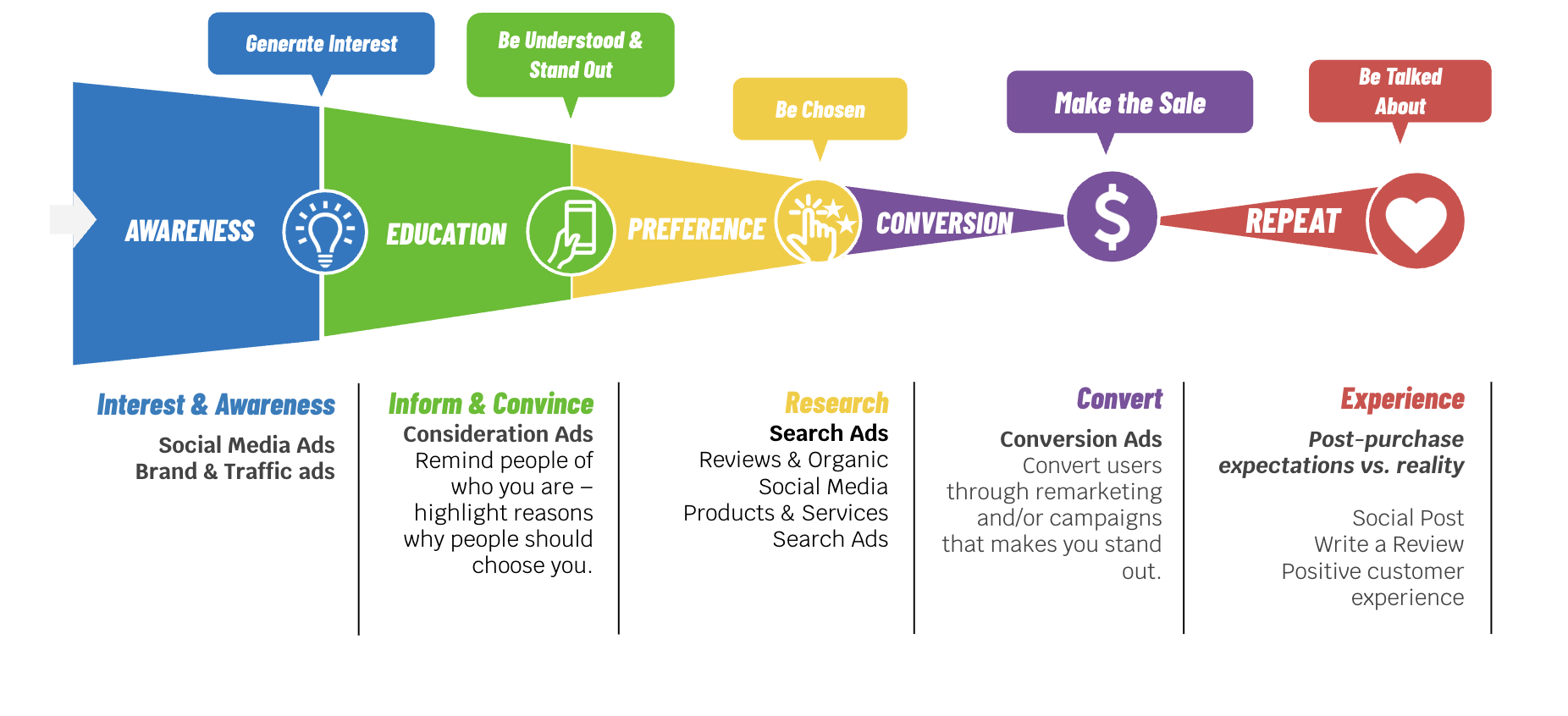
It’s important to understand these stages because your advertising should be designed to meet people where they’re at and guide them naturally through the funnel.
Why Is The Customer Journey So Important When Measuring Success?
Imagine you’re throwing a dinner party. Would you judge the success of the night purely on whether guests ate all of the dessert, or whether they left having had an enjoyable overall experience?
Advertising shouldn’t be any different.
You want to evaluate performance holistically through the lens of the customer journey and the specific outcomes associated with each stage.
Each stage requires:
- Different messaging
- Different creative
- Different tactics
- Different success metrics
This becomes even more important today because attribution is less straightforward than it used to be. Privacy updates, cookie limitations, and fragmented customer behaviour mean conversions are rarely driven by a single interaction anymore.
Businesses that only look at final-click attribution often undervalue the campaigns responsible for building trust and intent earlier in the journey.
How Is AI Influencing The Customer Journey?
AI is revolutionising how businesses manage and optimise the customer journey itself.
Advertising platforms now use machine learning to analyse behavioural signals across different stages of the funnel, helping campaigns adapt based on how users interact with content, websites, and ads over time.
For example, AI can help:
- Identify which audiences are most likely to move from awareness to consideration
- Optimise ad delivery based on engagement behaviour
- Personalise messaging across different stages of the journey
- Automate retargeting sequences
- Predict which users are more likely to convert or return
This allows businesses to create more tailored experiences throughout the funnel rather than treating every customer interaction the same way.
However, there’s an important distinction to make.
AI can improve efficiency across the customer journey, but it still relies heavily on the quality of the underlying strategy.
If the funnel itself is weak, unclear, or disconnected, automation can end up amplifying those problems rather than solving them.
For example:
- Driving cold audiences straight to hard-sell conversion campaigns
- Serving the same messaging to every stage of the funnel
- Optimising for clicks instead of meaningful customer behaviour
- Automating journeys that lack trust-building or education
The strongest customer journeys still require strategic thinking around:
- Messaging sequencing
- Customer intent
- Trust development
- Creative direction
- UX and landing page experience
- Long-term retention
AI can support the journey operationally, but businesses still need to design the journey intentionally.
How Should Success Be Measured Across The Customer Journey?
We hope it’s now clear that when it comes to advertising, not every stage of the journey is about making the sale immediately.
We measure success based on where the customer is in the funnel and what the campaign is designed to achieve.
Which is why looking only at sales or ROAS can sometimes be misleading. A healthy funnel has multiple layers, each requiring its own success markers.
Each point of the journey has a unique purpose:
- Awareness: Build familiarity and reach new audiences
- Education: Nurture interest and educate customers on your value
- Preference: Position your brand favourably against competitors
- Conversion: Drive immediate actions like sales or sign-ups
- Repeat: Encourage loyalty and advocacy
What Metrics Matter At The Different Stages of The Funnel?
Top Of Funnel: Awareness
At this stage, people are only beginning to discover your brand, so the goal usually isn’t immediate purchase. Rather, the focus is on generating interest, familiarity, and recognition.
Primary Goal: Visibility and engagement
KPIs: Impressions, reach, video views, engagement rate, CTR
Today, video engagement and attention metrics have become increasingly important, particularly across Meta, TikTok, and YouTube. Platforms are placing stronger emphasis on watch time, engagement quality, and content relevance, rather than simply clicks alone.
Middle Of Funnel: Education and Preference
Here, your audience is curious. They’re researching, comparing and learning more about what you offer.
Your campaigns should focus on education, nurturing and building trust.
Primary Goal: Build familiarity and capture intent
KPIs: Time on site, add-to-cart rate, email sign-ups, landing page engagement, content interactions
This is also where broader ecosystem thinking becomes important. SEO content, email automation, retargeting, and paid social often work together to move customers toward conversion over time.
Bottom Of Funnel: Conversion
At this stage, we aim to turn intent into action.
If we’ve guided audiences effectively through the earlier stages of the funnel, they should now be ready to commit, so the experience should feel as seamless as possible.
Primary Goal: Drive purchases or sign-ups
KPIs: ROAS, cost per acquisition (CPA), conversion rate, revenue
That said, ROAS should still be viewed within context. Some campaigns influence future conversions that may not appear immediately inside platform reporting.
This is why businesses are increasingly combining platform metrics with broader reporting frameworks such as:
- GA4 behavioural analysis
- CRM reporting
- MER analysis
- First-party customer data
- Multi-touch attribution models
Why Does Retention Matter After The Sale?
Post-Purchase: Retention and Repeat
The funnel doesn’t stop once someone converts.
We want customers to continue coming back to your brand and ideally advocate for it as well. That’s where retention-focused campaigns become incredibly valuable.
Primary Goal: Build loyalty and long-term value
KPIs: Repeat purchase rate, customer lifetime value (CLV), customer retention rate, email engagement
As acquisition costs continue rising across many platforms, retention is becoming increasingly important for long-term profitability.
Brands focusing only on acquisition often overlook how much growth can come from improving customer lifetime value and repeat purchase behaviour.
What Does Advertising Data Actually Tell You?
An extension of this discussion is understanding what the numbers on your dashboards actually mean in relation to the customer journey.
A question we always encourage clients to ask when reviewing data is: What does this actually tell me about where customers are in their journey?
Here’s how we approach it at Omni Online:
Attribution Modelling With Context
Rather than crediting only the final click, we map out which touchpoints helped move customers through the funnel.
Doing so gives us a clearer understanding of how each stage contributes to the bigger picture.
Cross-Channel Storytelling
Customers don’t live inside one platform, therefore your reporting shouldn’t either.
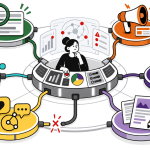
It’s important to evaluate how Google, Meta, email, SEO, organic social and direct traffic all work together. Google Search may capture the final conversion, but paid social may have generated awareness weeks earlier, while email and remarketing kept the brand top of mind.
Intentional Testing
The goal is uncovering what actually influences customer behaviour.
Whether it’s A/B testing creative, adjusting messaging, or trialling different audiences, testing should align strategically with the relevant journey stage.
All of this is to say: don’t just look at the numbers and make surface-level decisions.
Use them as signals that help explain:
- Where customers currently are
- How they’re progressing through the funnel
- What’s helping move them closer to conversion and loyalty
Final Thoughts: Why Looking At The Bigger Picture Matters
All in all, advertising success isn’t simply about generating immediate sales.
It involves building campaigns with the customer journey in mind and understanding how to evaluate success based on the stage your campaign is targeting.
Remember, each stage should have a different objective, and each stage should help move customers naturally toward the next one.
The businesses seeing the strongest long-term results today are generally not measuring channels or campaigns in isolation. They’re evaluating how the entire system works together across awareness, education, conversion, and retention.
That broader perspective becomes increasingly important as customer journeys become more fragmented and advertising platforms continue evolving.
Need help building campaigns that support every stage of the customer journey?
At Omni Online, we partner with eCommerce, B2B and wholesale brands to build sustainable digital strategies, optimise performance across the funnel, and align reporting with meaningful business outcomes rather than surface-level metrics alone.Book a Free Growth Strategy Call with our team to chat about how we can help you do the same.