When we say that AI has changed everything, we mean it.
Meta has continuously rolled out the most significant upgrade to its ad system in history, and it’s completely changing how advertisers build, deliver and optimise campaigns.
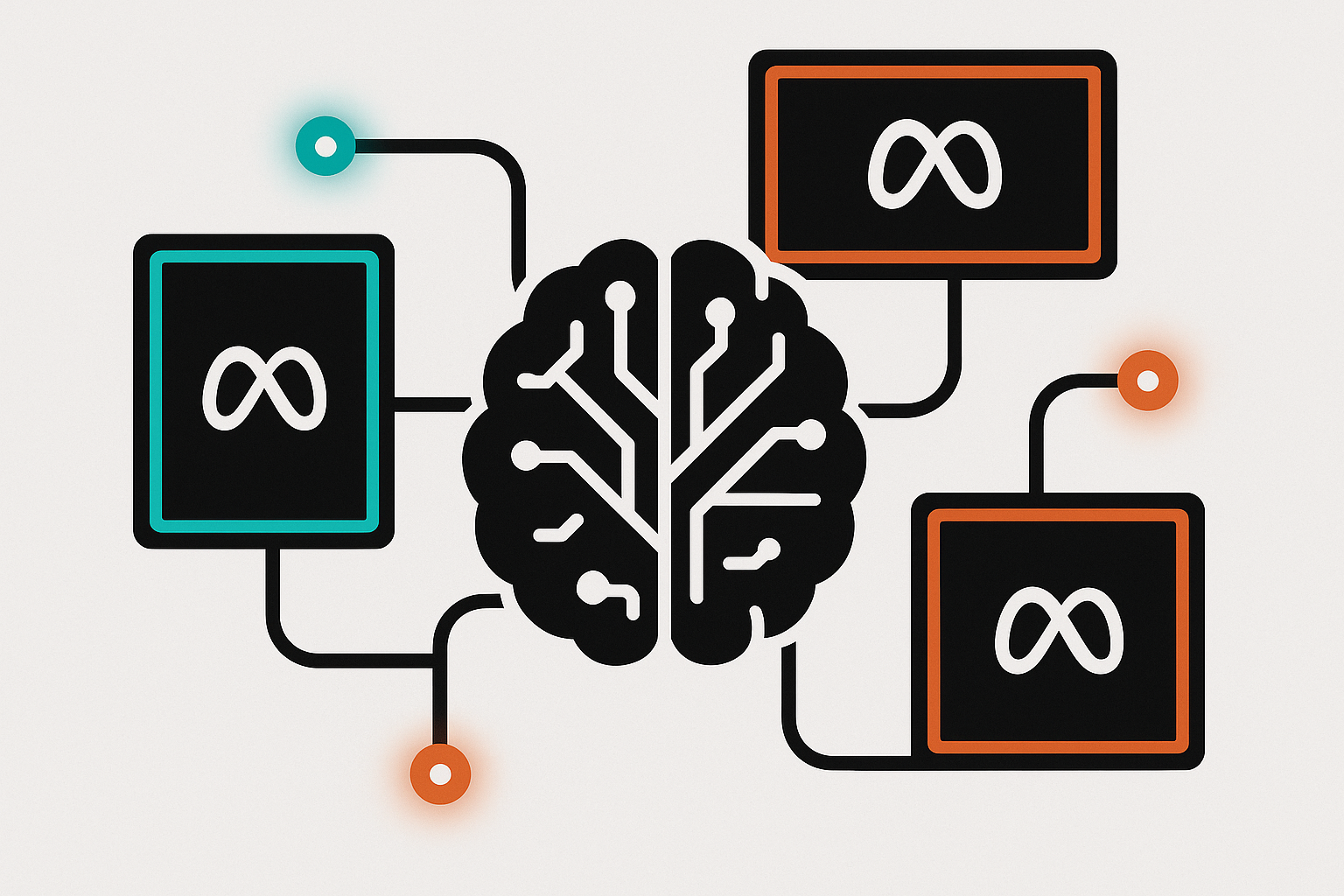
This shift is powered by Andromeda, Meta’s new AI engine, which Meta plans to fully automate by 2026. This means that businesses may only need to upload a product image, website link, and a budget…and Meta’s AI will handle the rest – from creative to targeting to optimisation.
If this sounds scary…that’s because it is.
The thought of losing control as Meta moves towards this entirely AI-driven landscape is terrifying. That is, if you don’t have the proper steps in place to take control of your advertising throughout these changes.
That’s why we’ve written this blog! To maintain control throughout these AI-driven changes, it’s important to understand what Meta’s Andromeda is, what’s changing, and what features are better suited for your brand than others.
What is Meta’s Andromeda Update?
Andromeda is a fancy name for the complete rebuild of how Meta decides which ads to show to whom and when. This replaces manual levers, like interest targeting and tightly segmented campaigns, with AI-driven prediction and real-time optimisation.
Simply put: Andromeda = fewer controls for advertisers, and more intelligence in the system.
Here’s what exactly has changed:
1. AI handles targeting
Instead of advertisers choosing interests or building stacks of lookalikes, Meta scans all available users and automatically finds the ones most likely to convert.
2. Creative becomes the number one performance driver
Your images, videos, copy and formats teach AI who your ideal customers are, meaning that the better the creative, the better the targeting.
3. All signals are unified
Meta merges your website data, app data, pixel signals, and ad engagement to inform its predictions.
4. Manual campaign structures matter less
Separate re-marketing, prospecting, or lookalike campaigns are no longer necessary.
AI blends signals across your campaign to optimise delivery.
This marks a fundamental shift away from “old-school” meta advertising and into a new era where your creative strategy and data matter more than your targeting skills.
How Meta’s AI Actually Chooses Which Ads to Show
There’s a 4-step process that takes place in milliseconds each time someone opens Facebook or Instagram:
- User Request: A person opens the app and scrolls
- Ads Corpus: Meta scans tens of thousands of eligible ads
- Hierarchical AI Model: Multiple AI models filter, rank and predict which ads the user is most likely to respond to
- Real-Time Delivery: Meta’s custom MTIA chops execute these decisions instantly
This system doesn’t just look at who the user is, it analyses:
- What creative elements catch their eye
- Which colours, styles,and formats they typically engage with
- What products they’ve interacted with before
- What behaviour signals they show in real time
It’s due to these reasons that creative variety is of significant importance within these AI-related updates.
Why AI-Driven Advertising Is The Future
Meta isn’t just adding AI as a feature, it’s reengineering its entire business around it.
According to Meta’s own 2026 automation blueprint, we’re heading towards:
- AI-generated ad creative (UGC videos, cutdowns, animations, text variants)
- AI-built audiences and prediction layers
- AI-managed budgets and placements
- AI-run multivariate testing
- Fully automated campaigns requiring minimal setup
And because the whole ecosystem is shifting in this direction, campaigns that fully embrace AI get preferential treatment in delivery, auction access, and learning speed.
This brings us to the biggest question advertisers are asking…
Should You Opt Out of Meta’s AI Enhancements?
Our honest take around this most asked question:
You can opt out, but we wouldn’t recommend it.
Meta still gives advertisers the ability to disable certain AI features like:
- Advantage+ Placements
- Advantage+ Audiences
- Creative enhancements
But the truth is simple: Meta prioritises campaigns that use AI, so opting out would be unfavourable to your campaign.
Meta built Andromeda assuming advertisers would feed it maximum flexibility, signals, and creative diversity. If you turn AI features off, you’re essentially working against the system.
Does AI get everything right? No, but it does get most things right.
We’ve found that AI optimisation tends to be:
- 90% correct: in audience identification, creative matching, placement decisions and conversion prediction
- 10% not ideal: occasional performance dips, leaning volatility, or strange creative enhancements
At Omni, we believe in utilising a balanced approach; leveraging AI where it consistently proves to have the capacity to outperform humans, and relying on manual control where human strategy is necessary.
Where AI Is Able To Outperform Humans
1. Audience Selection
Meta’s AI knows more about user intent and behaviour than any interest list could, and can detect mirco-patterns across billions of data points. Need we say more?
2. Real-Time Optimisation
AI adjusts in milliseconds based on:
- User behaviour
- Creative fatigue
- Auction competition
- Time of day
- Device
- Predicted conversion likelihood
These types of optimisations aren’t something humans can outperform, nor should we pretend we can.
3. Placement Decisions
AI understands where each individual user is most likely to convert, whether that be through Stories, Reels, Feed, Messenger, Marketplace, etc.
Where Humans (and Agencies) Still Outperform AI
While Meta’s AI is undeniably powerful, the updates don’t remove the need for human involvement, they actually increase it. As the platform becomes more automated, brands must rely even more heavily on strategic decision making to ensure the system is pointed in the right direction.
AI can optimise delivery, but it cannot replace strategic judgement that your agency brings across:
1. Strategy & budget Direction
Meta’s automation removes manual controls, which means advertisers now carry more responsibility in deciding:
- Whether push or pull strategies are appropriate
- How campaigns integrate with wider digital marketing activities, such as organic socials, email marketing, influencer activity and website development
- How to allocate budget between awareness, consideration and conversion
- When to scale, pause or restructure campaigns
- How to guide AI with the right signals and creative volume
This requires a deep understanding of both marketing strategy and AI behaviour; a combination Meta’s AI cannot replicate.
2. Optimisation of Decision-Making
Although AI handles real-time delivery, humans still outperform when determining:
- Which ad types and formats to use
- How creative should be refreshed or rotated
- When budget should be shifted (including why performance changed, not just that it did)
- What messaging resonates at different funnel stages
- How to diagnose volatility or unexpected performance swings
AI can optimise, but only based on what it’s given. Humans are needed to ensure the inputs are strategically sound.
3. Creative Direction & Brand Alignment
Creative is now the number one performance driver, and also the area where AI falls short most often.
Humans are still essential for:
- Developing the overarching creative strategy
- Choosing formats and concepts appropriate for each funnel stage
- Ensuring brand tone, emotion and nuance are correct
- Protecting brand safety and preventing misaligned or distorted AI-generated visuals
While AI is extremely useful, it doesn’t always understand brand tone, nuance, or sensitive creative guidelines. This is why we use AI-generated creatives with caution – the risk of odd or misleading regenerations is possible.
4. Reporting, Interpretation & Insights
AI can show you numbers, but it can’t tell you the story behind them. Human expertise is required to:
- Understand why performance changes occurred
- Interpret data through the lens of business goals
- Provide actionable recommendations
- Translate AI outputs into meaningful insights for stakeholders
- Connect campaign learnings to broader marketing activity
Reporting is where strategic value becomes most visible, and AI simply isn’t capable of this depth of insight.
AI-Generated Creative Assets
One of the biggest advancements in Meta’s AI leap is in the ability to generate creative assets automatically (which again, we recommend testing with caution).
This is a direct response to Meta’s finding that creative quality is now the single strongest performance driver within this new era of AI-optimised advertising.
Since creatives influence targeting, conversion prediction, and user response signals, Meta has begun building AI systems that can produce the content it needs to optimise performance.
Here’s a snapshot of what Meta’s AI can generate:
1. Multiple versions of your existing images
Meta can automatically create variations such as:
- New backgrounds
- Colour adjustments
- Depth and lighting enhancements
- New layout compositions
- Object highlighting
- Size and format adjustments for each placement (Reels, Stories, Feed, etc.)
This can help the system test which style resonates with each user.
2. UGC-style videos created from one photo
Meta’s new video-generated tools can turn a single static product image intO:
- Short-form Reels
- Animated showcases
- UGC-style testimonial-style clips
- Dynamic motion ads
This drastically reduces the need for brands to produce constant video content. Which is something the algorithm does heavily prefer.
3. Auto-generated headlines, primary text and CTAs
Meta’s AI can build new copy variations designed for:
- High intent
- Emotional response
- Click-through optimisation
- Engagement hooks
- Short-form and long-form structures
Your original copy acts as source, while Meta creates multiple versions for testing.
4. Creative built from scratch – coming by 2026
According to Meta’s 2026 blueprint and industry reporting, Meta aims to allow advertisers to upload:
- One product image
- A URL
- A budget
Based on these, the AI will create entire ads in all formats; videos, images, captions, hooks, CTAs, audience targeting and placement.
This makes it clear that Meta is working towards building a full-funnel creative generation powered by generative AI.
Yes, these features are impressive…but not all AI creatives are good creatives
While AI-generated creatives can massively scale testing and speed, it’s definitely not perfect, and should not be relied on.
Omni’s internal testing, as well as industry feedback, showcases issues such as:
- Unnatural-looking image alterations
- Off-brand backgrounds
- Overly generic UGC styles
- Slightly distorted product shapes
- Emotional tones that don’t match the brand
- Misleading or irrelevant AI-added elements
So while we do recommend testing out these features, they’re not a place where they can be a replacement for professional creative strategy. This is why Omni doesn’t enable AI creative enhancements by default, particularly for premium, brand-sensitive clients.
Final Thoughts: AI Isn’t Optional
It’s evident that Meta’s new AI ecosystem is here to stay, and will only continue to develop and become increasingly sophisticated. If your brand chooses to ignore it, your performance will take the hit.
We recommend a hybrid approach which blends the best of both worlds:
- AI-driven prospecting
- Human-led creative direction
- Selective manual optimisation
- brand -safe strategic oversight
- Real performance date from real accounts
In doing so, you won’t only adapt to Meta’s AI revolution, but thrive in it.