AI has changed digital marketing in a majorly substantial way. But not always in the way that people expect.
The AI Transformation Series, Interview with Our Founder Danny Nathanson: Part 1
The world of digital marketing is no stranger to change. Yet, with the emergence of AI and its accelerations, the pace of transformation in the industry is an evolution which is difficult to ignore.
The challenge for businesses isn’t whether AI will impact marketing. It’s understanding where that impact is creating genuine value and where human expertise still matters most.
As part of our three-part AI series, we sat down with Omni Online Founder, Danny Nathanson, to discuss how AI is reshaping digital marketing and what businesses should be paying attention to right now.
In this first article, we explore Danny’s perspective on AI’s impact on the marketing industry, where he believes businesses are seeing the biggest gains, and why he sees the future belonging to organisations that combine technology with expertise rather than relying on one or the other.
Here’s a snippet of some of the things discussed during our interview with Danny:
How Is AI Changing Digital Marketing Right Now?
When asked how AI is changing digital marketing today, Danny’s answer was immediate:
“AI has changed digital marketing in a majorly substantial way. But not always in the way that people expect.
There’s the obvious way of generating content and creating new ideas. However, that is almost 2025.
The real impact is on workflow and on being able to speed up and free up time that is at the moment being done on quite simple repetitive tasks. And it allows digital marketers to spend more time on creating strategies, campaigns, and really putting a lot of thought into how to differentiate themselves in a marketplace where AI is creating a lot of sameness amongst the content that people are creating.“
Danny’s perspective highlights an important shift.
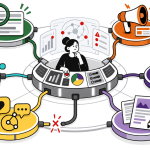
While much of the discussion around AI continues to focus on content creation, he believes the greater opportunity lies in improving workflows and reducing administrative effort, allowing marketers to spend more time on strategic thinking, creativity and differentiation.
Which Services Within Digital Marketing Is AI Impacting the Most?
AI is now influencing every service area within digital marketing, here’s what Danny has to say:
“AI has impacted on all of the services that we deliver within Omni Online. Initially, it was really focused on content creation and idea generation. But to be honest, it created a lot of sameness amongst a lot of the content that was created.
The real benefit and the real efficiencies come from repetitive tasks that we can input our current processes into and use AI to help us speed up the delivery.”
Danny believes the conversation has moved beyond simply using AI to generate content. Instead, the real value is emerging in areas where businesses can improve operational efficiency, automate repetitive processes and enhance service delivery.
He also points to the growing importance of custom GPTs and AI agents.
“A lot of the activities that are now happening within content creation are around using more advanced AI processes such as custom GPTs and agents where we have to take the knowledge out of our own heads and actually use that to train up our own custom AI models so that it’s not just a generic answer that we’re receiving. It’s something based on our own expertise and our own processes.”
Looking ahead, Danny sees AI playing an increasingly important role across services such as SEO, content, video production and reporting, particularly where routine activities can be enhanced by automation while still benefiting from human expertise.
Which Marketing Roles Will AI Enhance, and Which Roles Will Struggle?
Rather than viewing AI as a replacement for marketers, Danny sees it as a tool that will enhance certain aspects of marketing roles while changing the nature of others.
“The big shift that I see happening in this year is a lot of the more in-depth part of the marketing processes and the service delivery will now be starting to be AI enhanced.
Probably the most dramatic impact is going to be in routine activities such as reporting where we can get AI to understand the way that we want to report, look at previous reports and processes that we had in place and then on a regular basis emulate that and assist in the AI generation of routine reports.”
In Danny’s view, repetitive and process-driven activities will see the greatest transformation. Meanwhile, skills such as strategic thinking, creativity, customer understanding, commercial decision-making and relationship building will become even more valuable.The marketers most likely to thrive will be those who learn how to work alongside AI, using it to enhance their capabilities rather than viewing it as either a threat or a shortcut.
What Happens to Content Marketing When Everyone Can Create Content Instantly?
For Danny, one of the biggest challenges created by AI is content saturation.
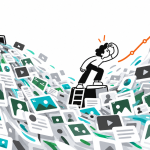
“When everyone is using AI to generate content, it inevitably leads to a blandness and the sameness amongst all of the content that’s generated. To a point where we can generally look at a piece of content and know straight away whether it’s been AI generated or not.”
As AI-generated content becomes increasingly common, Danny believes the competitive advantage no longer comes from simply producing more content.
Instead, the competitive advantage comes from combining AI with human expertise.
“The skill now is in utilising the team and human input to create a customised version of the AI models that are very specific to, firstly, the agency, secondly, to each sector, and then to each client.
Every bit of content that comes out is a mixture of what we have looked at and researched and done before in terms of brand guidelines and successful content, but also our input in terms of where the strategy is going and what are we trying to achieve.”
For Danny, the future of content marketing lies in using AI to accelerate execution while ensuring strategic thinking, industry expertise, audience understanding and brand positioning remain firmly driven by people.
What Marketing Activities Should Businesses Stop Doing Manually Today?
When asked where businesses should begin with AI, Danny’s answer was practical.
“The first thing that every business should look at in terms of using AI to replace what they’re really doing or to enhance what they’re really doing is any activity which is repetitive and which does not involve a lot of manual intellectual input along the way.”
He points to reporting as one of Omni’s earliest and most successful use cases.
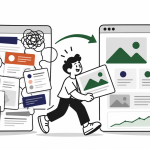
“It was a very manual process to gather the information from various different sources and to put it into a document and then to put it into a specific presentation format for each client.
That now is totally being replaced through an AI process which generates the monthly report and then puts it into a template based on each client’s requirements.”
Importantly, Danny stresses that AI is not eliminating human involvement.
“Our team involvement is then to analyse all of that and to come up with what are the insights and what are the changes that we need to make based on that content rather than spending our time creating the reporting in the first place.”
His advice to businesses is simple: identify repetitive, low-impact tasks, document the process, and then look for opportunities to use AI to replicate that process consistently and efficiently.
What Marketing Activities Aren’t at the Stage of Being Fully Automated?
While Danny sees enormous potential in AI, he is equally clear about its limitations.
“Not all services are at the stage that AI can be used to automate and to generate the actual outputs in a way that’s at a level that’s high enough for us to use within the agency.”
Visual creative disciplines remain one of the strongest examples.
“While AI can help with photo and video production, at the moment these are not yet at a level that we would be happy to provide to our clients as a final output.”
For Danny, this highlights a common misconception about AI.
“A lot of people view AI as being a total replacement for human involvement, and our view is that it is an enhancement to what the team is already doing, not a replacement.”
This philosophy underpins Omni’s broader approach to AI adoption. The objective is not to remove people from the process, but to help skilled professionals work more effectively.
Which AI Platform Do You Personally Use Most?
Like many businesses, Omni has experimented extensively with AI platforms over the past 18 months.
“We’ve gone on quite a journey at Omni trying every available AI platform, whether it is one of the larger ones such as ChatGPT and Claude, through to some very specialist ones which relate to graphic design or video generation.”
Today, Danny says ChatGPT has become Omni’s primary AI platform, although it is not the only one the agency uses.
However, he believes the platform itself is less important than how deeply a team understands it.
“My view is that each of the major LLM models are really leapfrogging each other from time to time. At one stage ChatGPT will be ahead, then Claude, then Gemini, and each will leapfrog each other with new features and platforms that you can use.”
His advice is straightforward:
“I think it’s more important for a team to pick one and to understand it really well and to do as much as you can within one platform.”
At Omni, that journey has evolved from simple prompts and conversations through to custom GPTs, AI agents, skills, workflows and multimodal capabilities spanning text, images and video.
For Danny, the real advantage comes not from chasing every new tool, but from building capability, processes and expertise within the platform you choose.
The Bigger Picture
Throughout our conversation with Danny, one theme consistently emerged.
The most valuable applications of AI aren’t about replacing people. They’re about helping people focus on higher-value work.
Whether it’s reporting, content creation, research, service delivery or workflow management, Danny believes the organisations seeing the greatest success with AI are those using it to remove friction, improve efficiency and create more capacity for strategic thinking.
In many ways, AI’s greatest impact on marketing may not be what it creates.
It may be the time it gives back to marketers to focus on the work that matters most.
Coming Up in Part 2: Omni’s Journey With AI
In the next instalment of this series, we’ll shift from industry-wide trends to Omni’s own experience with AI.
Danny and the team share how the agency evolved from experimenting with AI tools to developing custom GPTs, documenting processes, building AI agents and integrating AI into everyday operations.
We’ll also explore what worked, what didn’t, and the biggest lessons Omni has learned along the way.